




The Big Picture
Current work in our lab focuses on the distributed cognitive networks that enable stable perception and cognitive abilities that allow us to adaptively engage with a dynamically changing world. Specifically, we investigate brain dynamics and computations that allow us to update our beliefs about the environment while simultaneously maintaining internal information to guide ongoing behavior. We also seek to leverage these biological insights to develop targeted treatments for complex neuropsychiatric disorders and to pioneer novel, biologically inspired architectures that advance artificial intelligence.
Ongoing Projects
Understanding Dynamic Internal Representations In Brain Networks
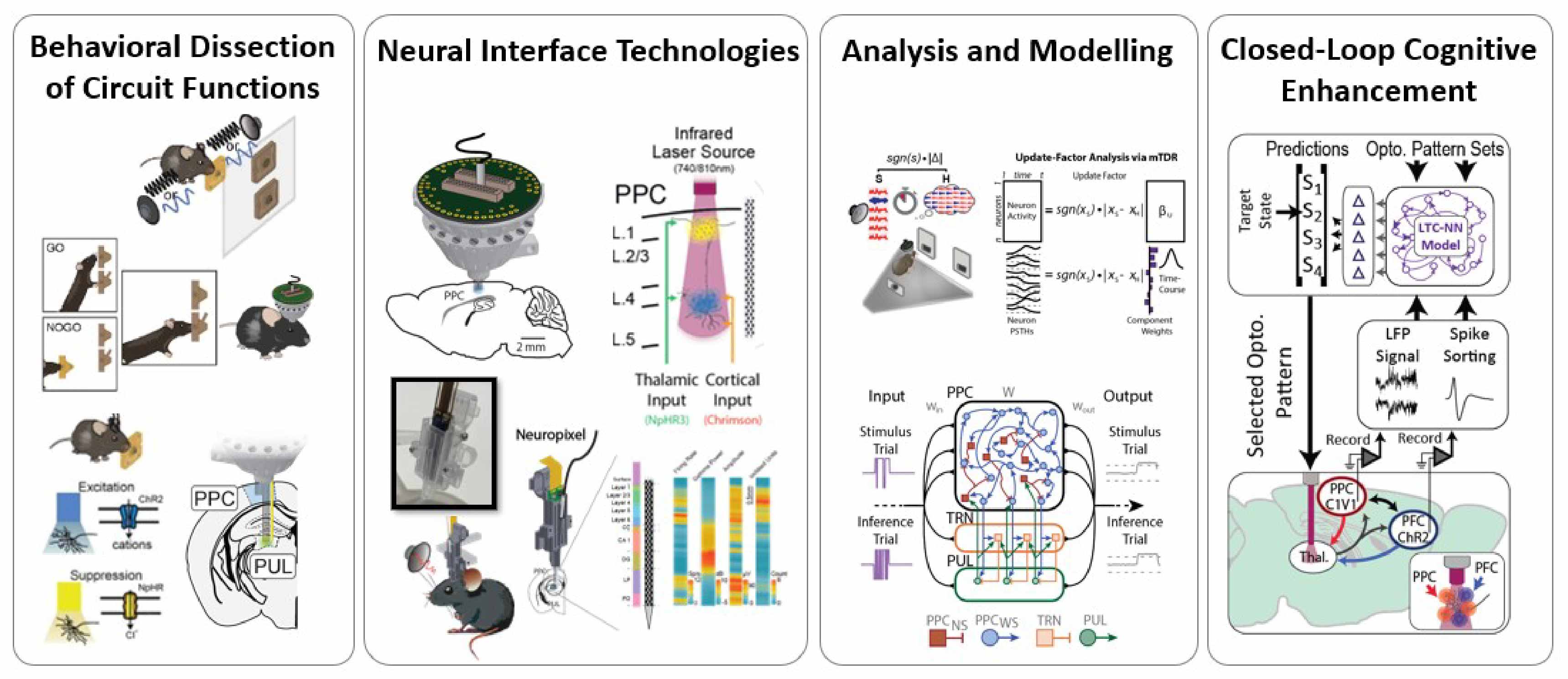
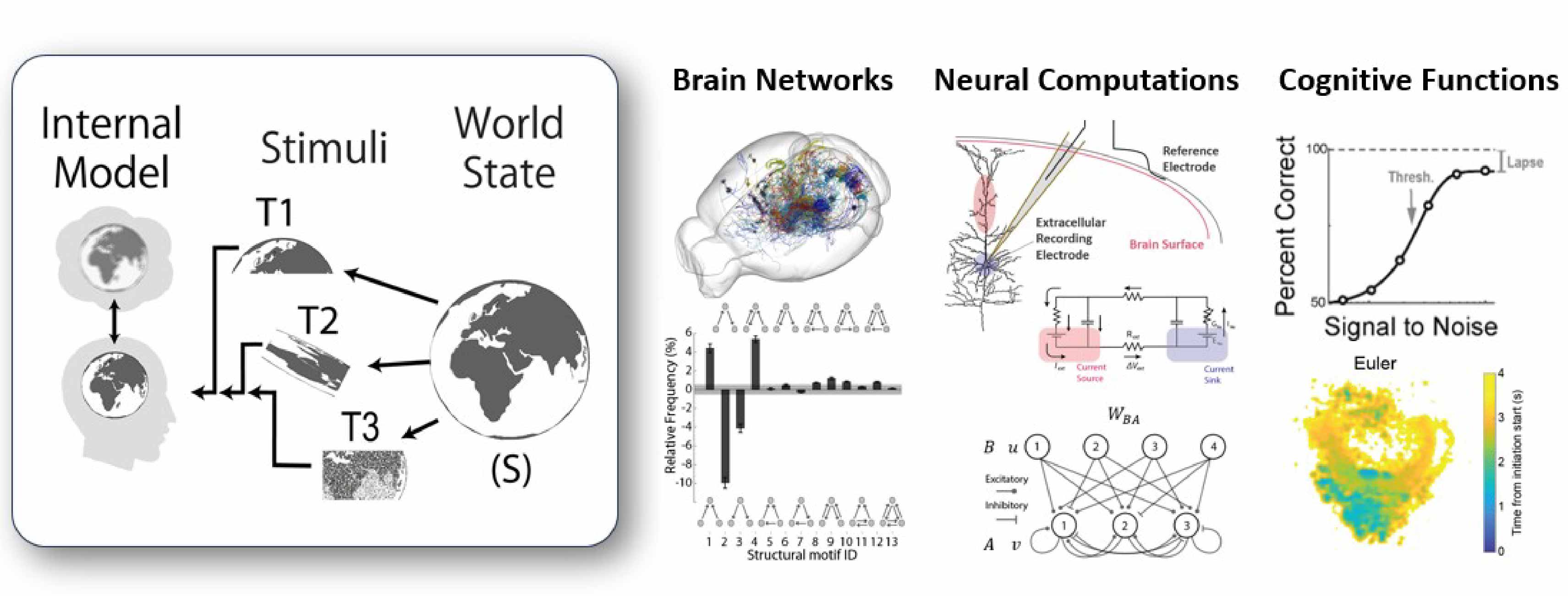
While our senses provide rich information, they can only capture isolated, momentary samples, providing a fundamentally discontinuous and frequently noisy picture of what is going on around us. How does the brain connect this noisy information to construct a coherent internal representation of the outside world, and how might disruption of this capacity cause distraction or even lead us to lose touch with reality? In this project, we investigate how the brain creates an internal model of the world and updates it to track changing conditions. This model is made up of much more than just static memories, containing implicit relationships and subtle impressions that allow us to keep track of the current situation and make intuitive judgements. Using behavioral approaches combined with optogenetics and advanced recording techniques, we seek to understand computations and network dynamics that underlie these capabilities. These methods also allow us to investigate how a lack of stable perceptual tracking can lead to distractibility and lack of focus, as well as how excessive or biased intuitive judgements can create delusional beliefs and even hallucinations.
Elucidating the Principles of Brain Network Dynamics that Create Flexible Behavior and Curiosity
Cognitive flexibility is our vital ability to pivot our thoughts, update strategies, and adapt behavior in an unpredictable world. To do this, the brain must rapidly modify its neural networks for every new scenario we encounter. But this raises a profound paradox: How does the brain prevent total cognitive chaos and maintain stable performance when it is actively destabilizing its own networks to switch between complex tasks? We tackle this problem by recording the real-time activity of key neuronal cell types to uncover the hidden microstructures and population dynamics that anchor local and brain-wide networks. Furthermore, we expand this investigation into an even more volatile neural state: curiosity. Curiosity naturally pushes the brain into a state of deliberate, heightened instability—breaking open rigid network configurations. By mapping this boundary between stability, controlled exploration, and purely chaotic behavior, we ultimately seek to understand how the brain leverages deliberate instability to foster creativity and learning.
Clinical Translation: Rethinking Psychiatric Symptoms
Our goal is to discover novel treatment strategies by deeply understanding underlying neural dynamics. We approach psychiatric symptoms with a unique philosophical question: Why did the brain evolve the capacity for these states in the first place? Rather than viewing neuropsychiatric symptoms purely as system failures, we seek to understand them through the lens of underlying neural dynamics and evolutionary adaptation. By understanding the evolutionary purpose of these networks, we shift from just "blocking" symptoms to modulating the underlying circuit dynamics. This deeper understanding allows us to design precise, novel therapeutic approaches for individuals experiencing deleterious symptoms, aiming to restore cognitive balance without stripping away the brain's natural adaptive strengths.
Developing Novel Neural Technologies
Circuits in the brain form complex, dynamically changing networks and the interactions and activity of these networks underlies everything that we do and think. By simultaneously recording activity in multiple structures while engaging cognitive functions using tasks and manipulating neurons using optogenetic approaches, we seek to better understand how multi-area dynamics give rise to behavior.